
Tina just left us a 5 star review
★★★★★
on Google
Can Microdermabrasion Help With Acne and Dark Spots in Sterling VA
Acne can leave behind more than an occasional breakout. Even after the active pimples are gone, many people are left with dark marks, rough patches, enlarged-looking pores, or uneven skin texture. That can make the skin feel like it still looks “acne-prone” even when breakouts have become less frequent.
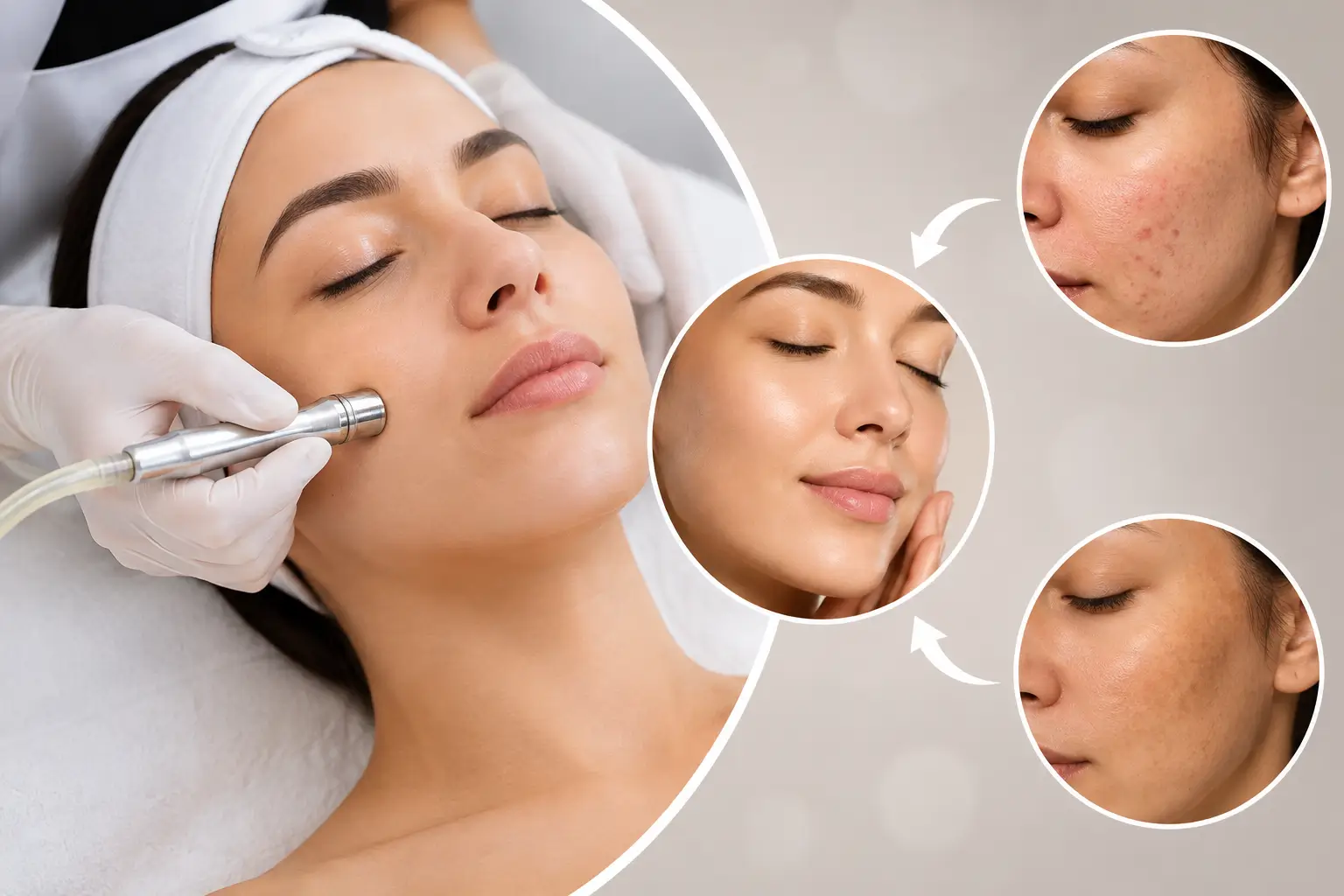
Microdermabrasion is a treatment many people turn to when they want smoother, brighter-looking skin and little to no downtime. It does this by gently exfoliating away some of the outermost dead skin cells, which can help to make the surface of the skin look more even.
But there is an important distinction between treating active acne, fading post-acne dark spots, and improving true acne scars. Microdermabrasion can be useful for some of these concerns, but it is not equally effective for all of them.
Microdermabrasion Sterling VA: What Can It Actually Do?
When people search for microdermabrasion Sterling VA , they are usually looking for one treatment that can address several concerns at once: breakouts, dark spots, rough texture, clogged pores, or old acne marks.
Microdermabrasion works mainly at the surface of the skin. The treatment gently exfoliates the outer layer, helping remove dead skin cells and leaving the skin feeling smoother. The American Academy of Dermatology notes that microdermabrasion can improve uneven skin tone and texture and can also help with dark spots that appear after acne clears.
That makes it more useful for post-acne marks and surface texture than for deeper problems within the skin.
For someone in Sterling, VA, considering the treatment, the better question is not simply, “Does microdermabrasion work?” It is, “What exactly am I trying to improve?”
If the concern is dullness, mild discoloration, rough skin, or uneven texture, microdermabrasion may be a reasonable option. If the main issue is deep pitted acne scarring or persistent inflammatory acne, a different treatment plan may make more sense.
Is Microdermabrasion Good for Acne?
Microdermabrasion for acne can be helpful in certain situations, particularly when the skin has clogged pores, surface buildup, or mild unevenness. The exfoliating action can leave the skin feeling cleaner and smoother, but it should not be treated as a standalone cure for acne.
Active acne is complicated. Oil production, clogged follicles, inflammation, hormones, bacteria, and genetics can all play a role. Removing dead surface skin cells does not address every one of those factors.
This is why the condition of the skin before treatment matters.
If someone has a few clogged pores and mild breakouts, a skincare professional may consider gentle exfoliation as part of a broader routine. On the other hand, skin that is highly inflamed, irritated, or covered with active lesions may not be a good candidate for aggressive exfoliation.
The goal should be to calm the skin rather than repeatedly scrub it.
Another practical point: more exfoliation does not automatically mean better results. Over-treating acne-prone skin can cause irritation, dryness, or sensitivity, which can make the skin look worse instead of better.
For ongoing or moderate-to-severe acne, it is worth addressing the acne itself rather than relying on cosmetic exfoliation alone.
Can Microdermabrasion Fade Dark Spots After Acne?
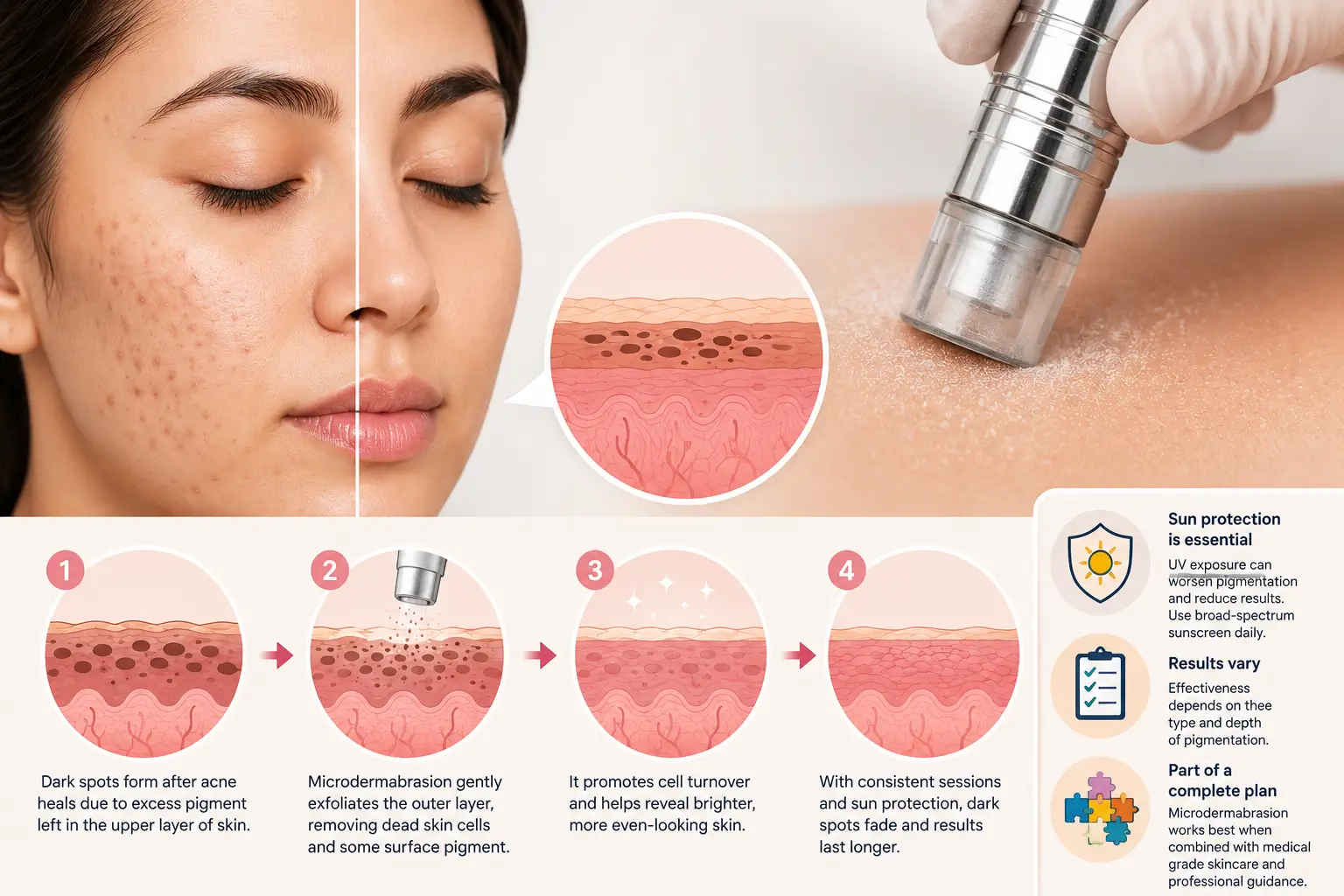
This is where microdermabrasion can make more sense.
After a pimple heals, the skin may leave behind a flat brown, gray, or reddish mark. These marks are often related to post-inflammatory changes rather than a true indentation in the skin. They can linger long after the original breakout has disappeared.
Microdermabrasion for dark spots may help improve the appearance of superficial discoloration by exfoliating the outermost layer of skin and promoting a more even-looking surface.
The American Academy of Dermatology specifically lists dark spots that appear after acne clears among the concerns for which dermatologists may use microdermabrasion.
However, results depend heavily on what caused the pigmentation in the first place.
A dark mark from a healed pimple is different from melasma. A sun spot is different from a deeper pigment disorder. Treating each one in exactly the same way is not always sensible.
Sun protection also matters more than many people realize. If the skin is repeatedly exposed to UV light after treatment, pigmentation can become harder to manage. The AAD notes that people who protect their skin from the sun tend to maintain microdermabrasion results longer.
So if fading dark spots is the goal, microdermabrasion should usually be considered one part of the plan rather than the entire plan.
What About Microdermabrasion for Acne Scars?
This is one area where expectations need to be realistic.
Microdermabrasion for acne scars may make the skin feel smoother and can improve the appearance of uneven surface texture, but it does not generally remove established, deep acne scars.
There is a difference between an acne mark and an acne scar.
A flat brown spot left behind after a pimple is pigmentation. A depressed area in the skin caused by lost or altered collagen is a scar. Microdermabrasion can help with the appearance of surface discoloration and unevenness, but it does not rebuild deep scar tissue.
The American Academy of Dermatology specifically states that microdermabrasion will not treat acne scars, although dermatologists may use it to even out skin tone as part of an overall approach.
For deeper acne scars, treatments such as microneedling, laser resurfacing, radiofrequency treatments, chemical peels, or other procedures may be considered depending on the scar type and the individual's skin.
That does not make microdermabrasion useless. It simply means the treatment should be matched to the problem.
If your main concern is a brown mark, think pigmentation. If you can see or feel an indentation in the skin, think scarring. That simple distinction can prevent a lot of disappointment.
How Microdermabrasion Can Improve Skin Texture
One of the more straightforward uses of microdermabrasion is improving the feel and appearance of the skin's surface.
Microdermabrasion for skin texture works by removing dead surface cells through controlled exfoliation. After treatment, many people notice that their skin feels softer and looks more polished.
It can be useful when the skin looks:
- Rough or uneven
- Dull
- Dry and flaky
- Slightly congested
- Uneven in tone
- Rough around areas affected by previous breakouts
The effect is generally more noticeable on surface concerns than deep structural problems.
This distinction is important because “texture” is a broad word. Someone may use it to describe tiny bumps and dry patches, while another person may mean deep acne indentations. Those are not the same concern and should not be approached with the same treatment.
Microdermabrasion is best viewed as a surface-level treatment. It can smooth what is sitting on top of the skin, but it cannot reshape deep scar tissue.
How Many Microdermabrasion Treatments Are Usually Needed?
One treatment can leave the skin feeling smoother, but longer-term improvement usually requires a series of treatments.
The exact number depends on the person's skin, the concern being treated, the strength of the treatment, and how the skin responds.
The American Academy of Dermatology notes that results become more noticeable after a series of treatments and that the results are temporary, meaning maintenance treatments may be needed.
This is one reason it is better not to judge the treatment based only on what the skin looks like immediately afterward.
A reasonable treatment plan should take into account:
- What you are treating.
- Whether you have active acne.
- How sensitive your skin is.
- Whether you develop pigmentation easily.
- What skincare products you currently use.
- How quickly your skin normally recovers.
Someone treating mild surface discoloration may have a very different treatment schedule from someone dealing with persistent congestion or uneven texture.
Is There Any Downtime After Microdermabrasion?
One of the reasons people choose microdermabrasion is that it generally involves little downtime compared with more aggressive resurfacing procedures.
The skin may look pink or red afterward and can feel slightly sensitive. According to the AAD, these effects commonly settle within about a day, although some people can experience sensitivity, stinging, bruising, or increased sensitivity to sunlight.
That does not mean you should treat the skin as if nothing happened.
Immediately after exfoliation, the skin needs a relatively simple routine. Avoid piling on multiple strong active ingredients simply because the skin feels smooth. Depending on the treatment and your provider's instructions, products containing retinoids, acids, or other irritating ingredients may need to be paused around the appointment.
Cleveland Clinic also notes that preparation for microdermabrasion may include temporarily stopping certain exfoliating products, retinoids, and other treatments.
The safest approach is to follow the specific aftercare instructions provided by the professional performing your treatment.
Can Microdermabrasion Make Dark Spots Worse?
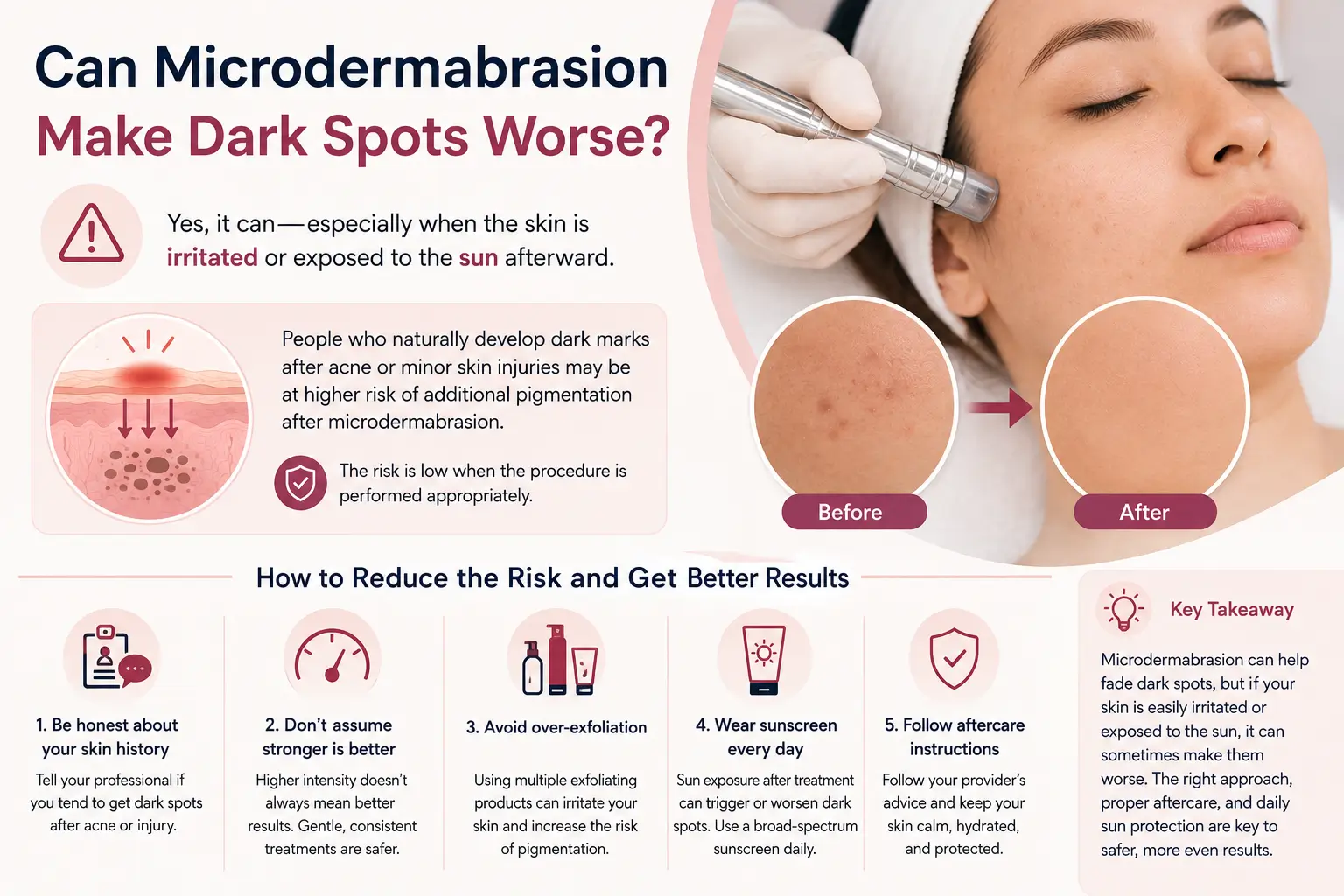
It can happen, particularly when the skin is irritated or exposed to the sun afterward.
This matters for people who naturally develop dark marks after acne or minor skin injuries. The AAD notes that people prone to developing dark spots after acne or injury may have a higher risk of additional pigmentation after microdermabrasion, although the risk is considered low when the procedure is performed appropriately.
This is one reason treatment intensity should not be chosen based on the idea that “stronger is better.”
If your skin tends to pigment easily, the professional performing the treatment should know that before starting. Your current skincare routine matters too. Using several exfoliating products at the same time can increase irritation.
Daily sunscreen is also important, particularly when the goal is to improve discoloration.
Who May Not Be a Good Candidate?
Microdermabrasion is relatively gentle, but it is not automatically appropriate for every skin condition.
Someone with severely irritated skin, an active skin infection, open wounds, or significant inflammation may need to postpone treatment. People using certain prescription medications or undergoing other cosmetic treatments should also discuss timing with their healthcare provider or skincare professional.
The key is to evaluate the skin as it actually looks on the day of treatment.
If you have active, painful, or worsening acne, it may be more useful to address the acne first. Treating the resulting marks is much easier when new inflammation is under control.
And if you are dealing with a pigmentation condition such as melasma, it is worth getting a proper assessment before assuming that exfoliation is the answer.
Microdermabrasion vs. Other Treatments for Acne and Dark Spots
There is no single treatment that is best for every type of acne-related skin concern.
For mild congestion and rough texture: microdermabrasion may be useful because it focuses on surface exfoliation.
For post-acne dark marks: microdermabrasion may help improve the appearance of uneven tone, particularly when combined with appropriate skincare and sun protection.
For active acne: acne-focused skincare or medical treatment may be more important than exfoliation.
For deep acne scars: microdermabrasion is usually not enough. The AAD recommends other scar-focused options depending on the type and severity of scarring.
For significant pigmentation: the cause needs to be identified first. Pigmentation may require a different combination of topical products or professional treatments.
This is why a consultation can be more useful than simply booking the strongest-looking treatment on a menu.
Must Read: Spa Sterling
What Should You Ask Before Booking Microdermabrasion in Sterling VA?
Before booking a treatment, ask a few practical questions.
First, ask whether the treatment is appropriate for your specific concern. “I have acne scars” is not enough information by itself. Are they flat dark marks, red marks, shallow depressions, or deeper pits?
Second, ask what type of exfoliation will be used and how your skin will be assessed beforehand.
Third, tell the provider about your current skincare routine. Retinoids, exfoliating acids, acne medications, waxing, peels, and other procedures can affect how your skin should be prepared.
Finally, ask what results are realistic after one treatment and after a full series.
A good provider should be comfortable telling you when microdermabrasion is not the best option. That is usually a better sign than someone promising that one facial will erase years of acne damage.
Final Takeaway
Microdermabrasion can be a useful treatment when the problem is mainly on the surface: dullness, mild congestion, rough texture, uneven tone, and some post-acne dark marks.
It is less appropriate to think of it as a cure for active acne or a solution for deep acne scars.
For someone considering treatment in Sterling, VA, the best starting point is to identify exactly what remains after the acne. If you have flat dark marks, the conversation is mainly about pigmentation. If your skin feels rough or looks uneven, surface exfoliation may help. If you have visible indentations, you are dealing with scarring and may need a different approach.
That distinction saves time, money, and frustration.
The most sensible treatment plan is usually the one that matches the actual skin concern rather than trying to make one procedure do everything. And when dark spots are involved, consistent sun protection and a suitable home-care routine are just as important as the in-office treatment itself.
Microdermabrasion can be useful for surface buildup, light congestion and uneven texture, but it is not a primary treatment for moderate to severe acne. Active inflammatory acne may need a specific acne treatment regimen. Microdermabrasion is generally more helpful for smoothing the skin's surface after or in between breakouts.
It can help improve the appearance of some post-acne dark spots by exfoliating the outermost layer of skin and making the overall complexion look more even. The AAD lists dark spots that appear after acne clears as one of the concerns for which microdermabrasion may be used. Results vary depending on the depth and cause of the pigmentation.
Microdermabrasion can help with surface smoothness and may diminish the appearance of some irregular areas. It does not, however, generally treat deep or established acne scars. The AAD specifically says that microdermabrasion doesn’t treat acne scarring. Deeper scars may need treatments that encourage collagen production or restructure scar tissue.
There is no fixed number that works for everyone. A series of treatments is commonly used when the goal is gradual improvement in tone and texture. The appropriate schedule depends on your skin's sensitivity, the severity of the discoloration, and what other treatments or skincare products you are using. Results are temporary, so maintenance may also be recommended.
Yes. Improving surface texture is one of the more established uses of microdermabrasion. By exfoliating dead skin cells, the treatment can leave the skin feeling smoother and looking more even. It is most useful for superficial roughness rather than deep acne indentations or significant scarring.
It depends on the type and severity of the acne and the condition of your skin. Highly inflamed or irritated skin may need to be calmed before exfoliation. If acne is persistent, painful, or worsening, treating the underlying acne should generally take priority over cosmetic resurfacing. A professional assessment can help determine whether microdermabrasion is appropriate.